
There are many good reasons to run a janitorial business, and it’s the kind of thing that is always going to be worth focusing on in a number of ways. If you do that you should be able to keep on top of it effectively. Running a janitorial business looks simple from the outside: turn up, clean, leave, repeat. In practice it’s closer to a logistics operation disguised as mops and clothes. You’re balancing staff schedules, client expectations, site variations, supply costs, and the constant pressure of margins that can disappear if one contract slips out of control. Keeping on top of it isn’t about working harder; it’s about building a system that stops small problems turning into silent leaks.

At the centre of most well-run cleaning businesses is consistency. Not consistency in the work itself – cleaning standards are usually straightforward – but consistency in how work is priced, delivered, checked, and adjusted. The moment those processes become informal or overly dependent on memory and goodwill, things start to drift. Jobs take longer than they should. Staff improvise more than they’re guided. Clients begin to notice small inconsistencies that slowly erode trust.
Scheduling
One of the first pressure points is scheduling. Janitorial work rarely happens in a neat, linear way. Sites have different access times, security restrictions, and frequency requirements. A school might need early morning cleans, while offices prefer evenings. Residential blocks may demand mid-day touch-ups in communal areas. Without a clear scheduling system, the day becomes a puzzle that reshuffles itself every morning. Digital scheduling tools can reduce that friction, but even a simple disciplined structure – where every site has a defined rhythm and backup cover plan – prevents a huge amount of chaos.
Staffing
The second pressure point is staffing. Cleaning teams are often distributed across multiple locations, which makes oversight harder than in a single-site operation. The temptation is to rely on verbal updates or informal messaging, but that quickly becomes unmanageable as you scale. Clear task definitions, paired with simple reporting routines, make a noticeable difference. When staff know exactly what “done properly” means for each site, you reduce interpretation drift. That’s where quality starts to fragment.
Supplies & Equipment
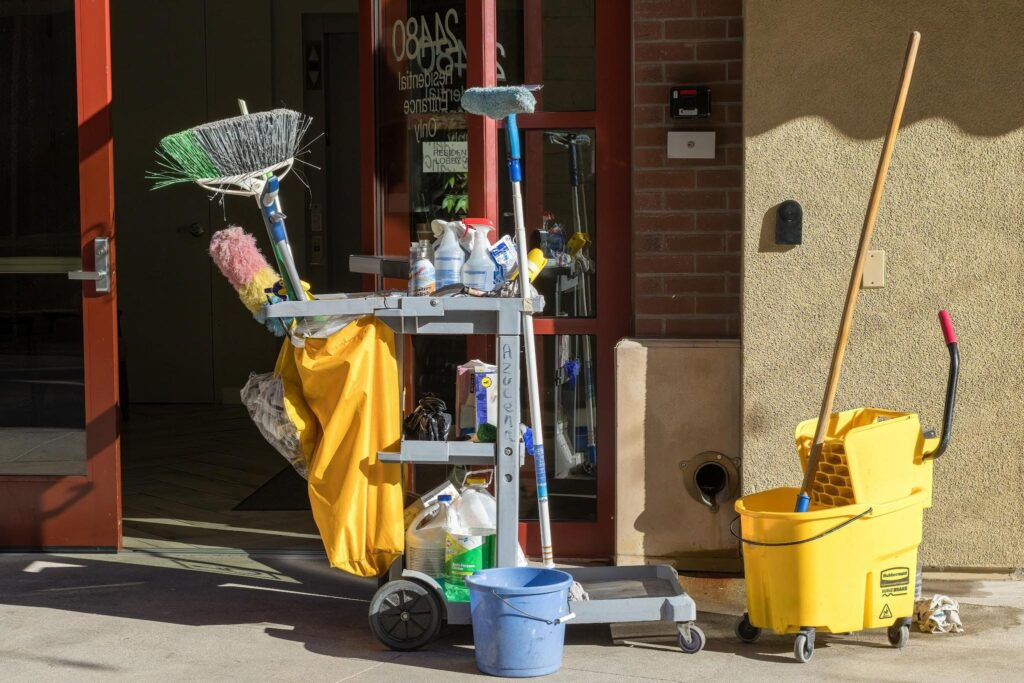
Then there’s supplies and equipment. It’s easy to underestimate how much operational attention is hidden in something as basic as stock control. Missing cleaning products don’t just delay work; they force improvisation, which usually leads to uneven results. A well-run operation treats consumables like inventory in a warehouse rather than an afterthought in a cupboard. Tracking usage patterns and replenishment cycles helps avoid both shortages and over-ordering, which quietly drains cash flow over time.
Clients & Quotes
Client management is another layer entirely. In janitorial work, expectations are often unspoken until they’re not met. A corridor that’s “usually fine” becomes a problem the moment it isn’t. This is why documentation matters more than most people think. Clear scopes of work, agreed standards, and regular review points keep conversations grounded in something tangible rather than subjective impressions. It also helps protect your team from unrealistic or shifting expectations.
Where many cleaning businesses start to feel strain as they grow is in quoting and contract management. Early on, pricing jobs might be quick and intuitive. You look at a site, estimate effort, and send a number. That approach stops working as soon as you have multiple contracts, different staffing costs, and variable site requirements. This is where cleaning proposal software becomes genuinely useful.

Modern cleaning proposal software allows you to standardise how you build quotes, turning what used to be a manual, experience-based process into something more structured and repeatable. Instead of starting from scratch each time, you can base proposals on predefined task lists, labour assumptions, and pricing models. This doesn’t just speed things up; it also reduces inconsistency between similar contracts. Two offices of comparable size should not end up with wildly different pricing just because they were quoted on different days by different people.
More importantly, it improves accuracy. When you break down cleaning requirements into measurable components – floor area, frequency, special tasks, consumables – you’re less likely to undercharge or overlook hidden effort. Many janitorial businesses don’t fail because they can’t win contracts; they struggle because they win unprofitable ones. Proposal software helps surface that risk earlier, before it becomes a problem in delivery.
There’s also a psychological advantage when dealing with clients. A structured, professional-looking proposal signals that your business operates with systems rather than guesswork. It changes the tone of negotiations. Instead of haggling over vague numbers, discussions shift toward scope adjustments and service levels. That’s a healthier and more scalable dynamic.
Quality Control
Quality control is another area where structure pays off. The most effective cleaning businesses don’t rely solely on client complaints or periodic inspections. They build lightweight internal checks that don’t slow operations down. This might be supervisor visits, photo verification on completion, or rotating audits of sites. The goal isn’t surveillance; it’s feedback. Without feedback loops, standards naturally drift over time, even with good staff.
Financial Aspects
Financial visibility ties everything together. Many janitorial businesses operate with surprisingly thin insight into which contracts are genuinely profitable. Labour hours, travel time, consumables, and rework often blur together unless tracked carefully. Without that clarity, growth can actually increase stress rather than stability. You add more contracts, but not necessarily more margin. Regularly reviewing performance at contract level helps identify where adjustments are needed, whether in pricing, staffing, or scope.
Ultimately, keeping on top of a janitorial business is about shifting from reactive to structured thinking. Instead of responding to problems as they appear, you build systems that make those problems less likely in the first place. Scheduling stops being ad hoc. Pricing becomes consistent. Quality becomes measurable. Communication becomes traceable. And tools like cleaning proposal software help connect those systems into something coherent rather than fragmented.